Capture HTTP/HTTPS Request from axios (NodeJS)
This blog will cover the following:
- How to capture HTTP/HTTPS Requests/Responses from axios library in NodeJS with Proxyman
1. Make a HTTPS Request with axios
If you're a Javascript/NodeJS developer, it's common to make HTTP/HTTPS REST Requests by using axios library. Axios provides handy promise-based APIs to help developers to make a Request easier.
Here is the benefit:
- Easy to use: Axios provides an easy-to-use API for making HTTP requests, which makes it a popular choice for web developers.
- Cross-platform compatibility: Axios can be used both in the browser and in Node.js, making it a versatile choice for developers working on web applications.
- Supports promises: Axios supports promises, which allows for asynchronous requests and makes it easy to handle responses.
- Supports cancellation: Axios provides a mechanism to cancel requests, which is useful in scenarios where the user navigates away from a page or when a request takes too long to complete.
- Interceptors: Axios supports interceptors, which can be used to modify requests or responses before they are sent or received.
- Error handling: Axios provides good error handling, allowing developers to easily handle errors in their applications.
- JSON data handling: Axios can automatically parse JSON data received from the server and transform JSON data sent in requests.
The following sample code demonstrates how we make a request with axios library.
import axios from 'axios';

var response = await axios.get("https://google.com");
console.log(response);

response = await axios.get("https://httpbin.org/get?lib=axios&schema=https");
console.log(response);

response = await axios.get("http://httpbin.org/get?lib=axios&schema=http");
console.log(response);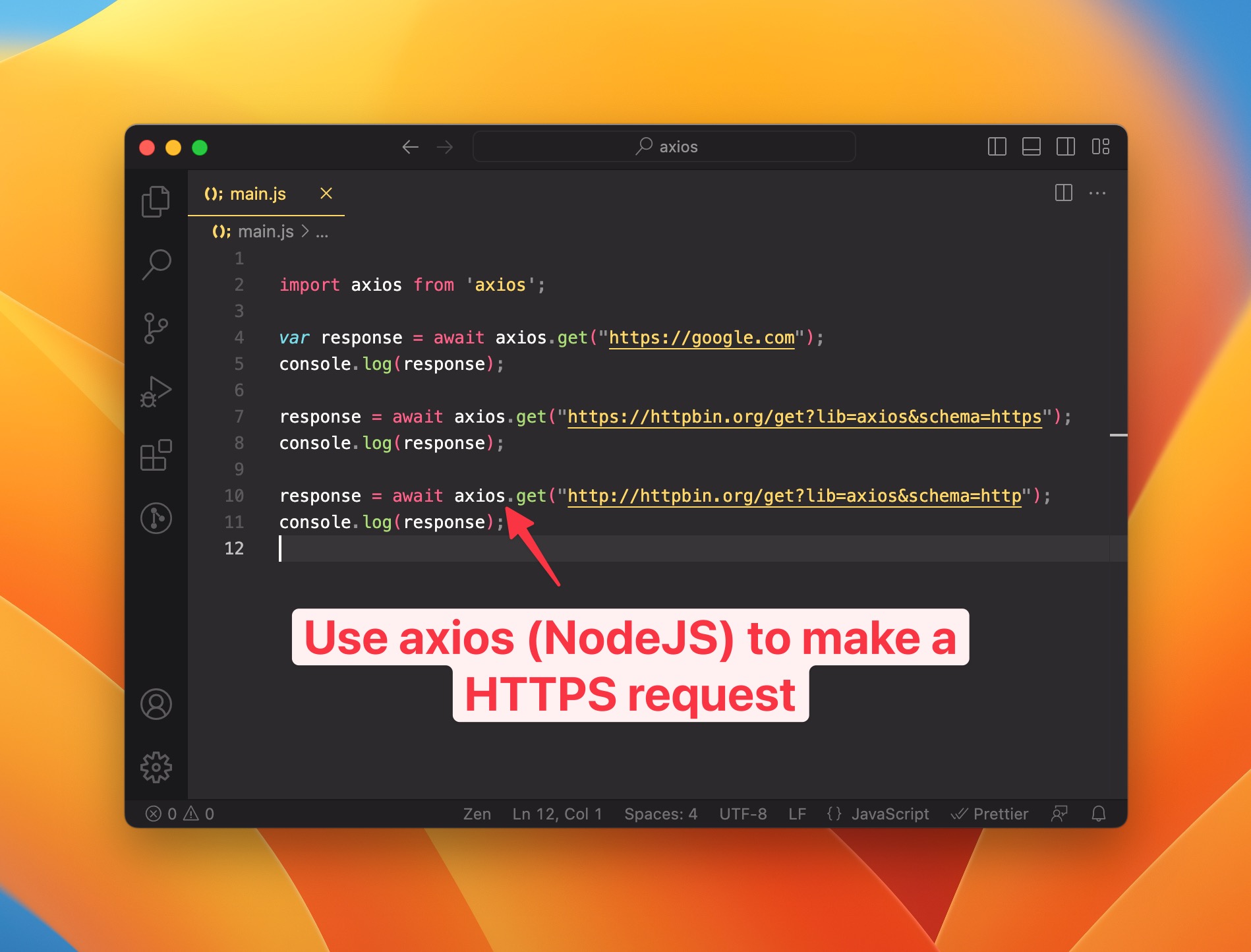
To run it:
- Save the sample code to
main.js - Open the Terminal on this directory: Run
npm init -yto create a simple package. - Install axios:
npm install axios node main.js- Done.
2. How to capture HTTP/HTTPS Requests / Responses ?
Current problem
Axios, by default, does not respect the System HTTP Proxy config. Thus, you won't see any Axios Request/Response from Proxyman or other web debugging proxy (e.g. Charles Proxy, or Fiddler).
To fix it, we have to manually config the Proxy. Here is a sample of how to achieve it. Read more at Axios Documentataion.
var response = await axios.get({
  url: "https://google.com",

  // Provide a Proxy config
  proxy: {
      protocol: 'https',
      host: '127.0.0.1',
      port: 9090
    },
});
It's error-prone and time-consuming because we have to manually alter the source code.
Solution ✅
Luckily, Proxyman has shipped a feature to help you capture HTTP/HTTPS Requests/Responses with zero-config.
- Download the latest macOS app at https://proxyman.com/
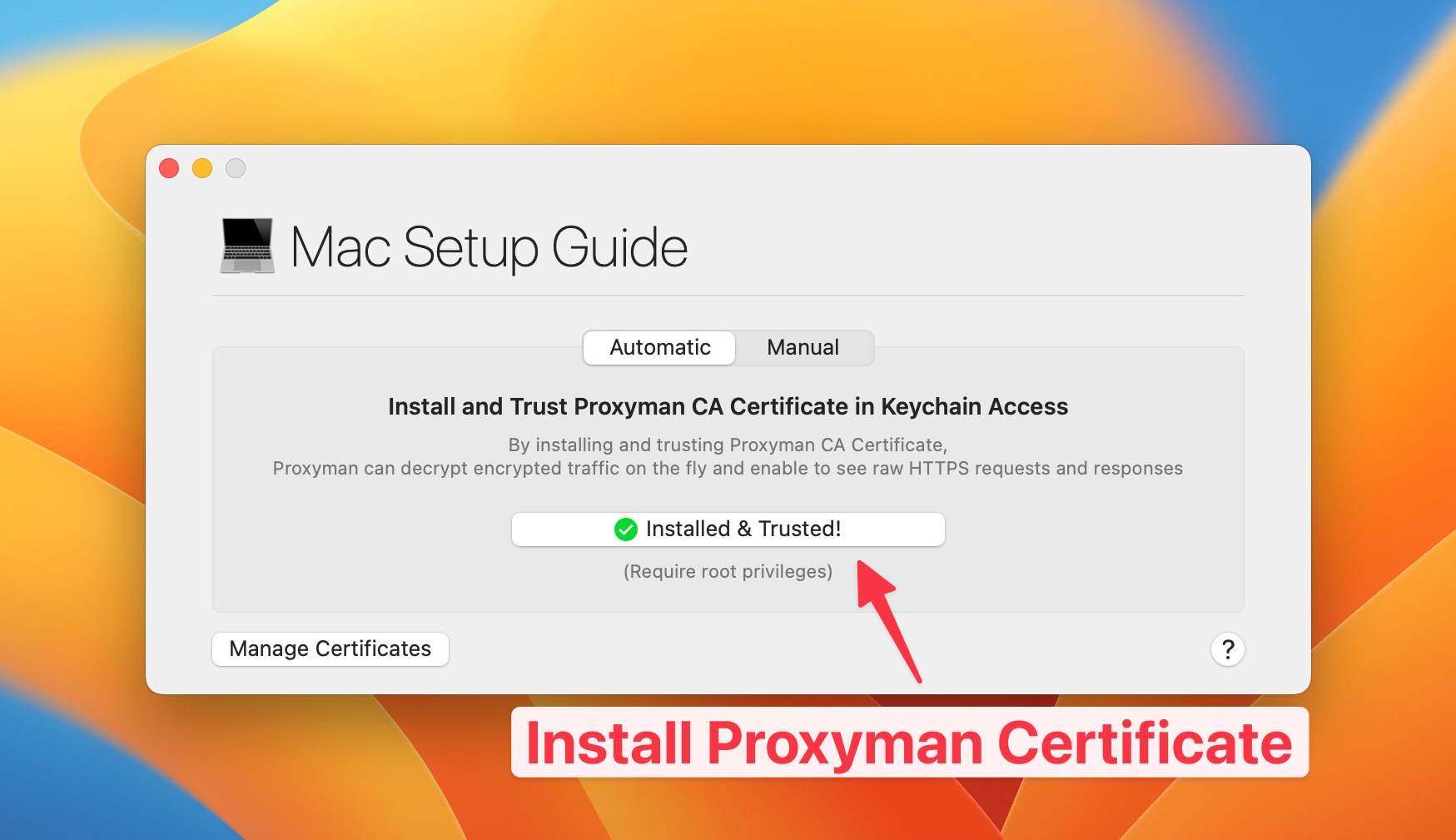
- Install the Proxyman certificate on your Mac. You can simply install it by opening the Certificate menu -> Install Certificate on this Mac… -> Click on the "Install & Trust" button.
- Open the Setup Menu -> Automatic -> Click on the "New Terminal app…"
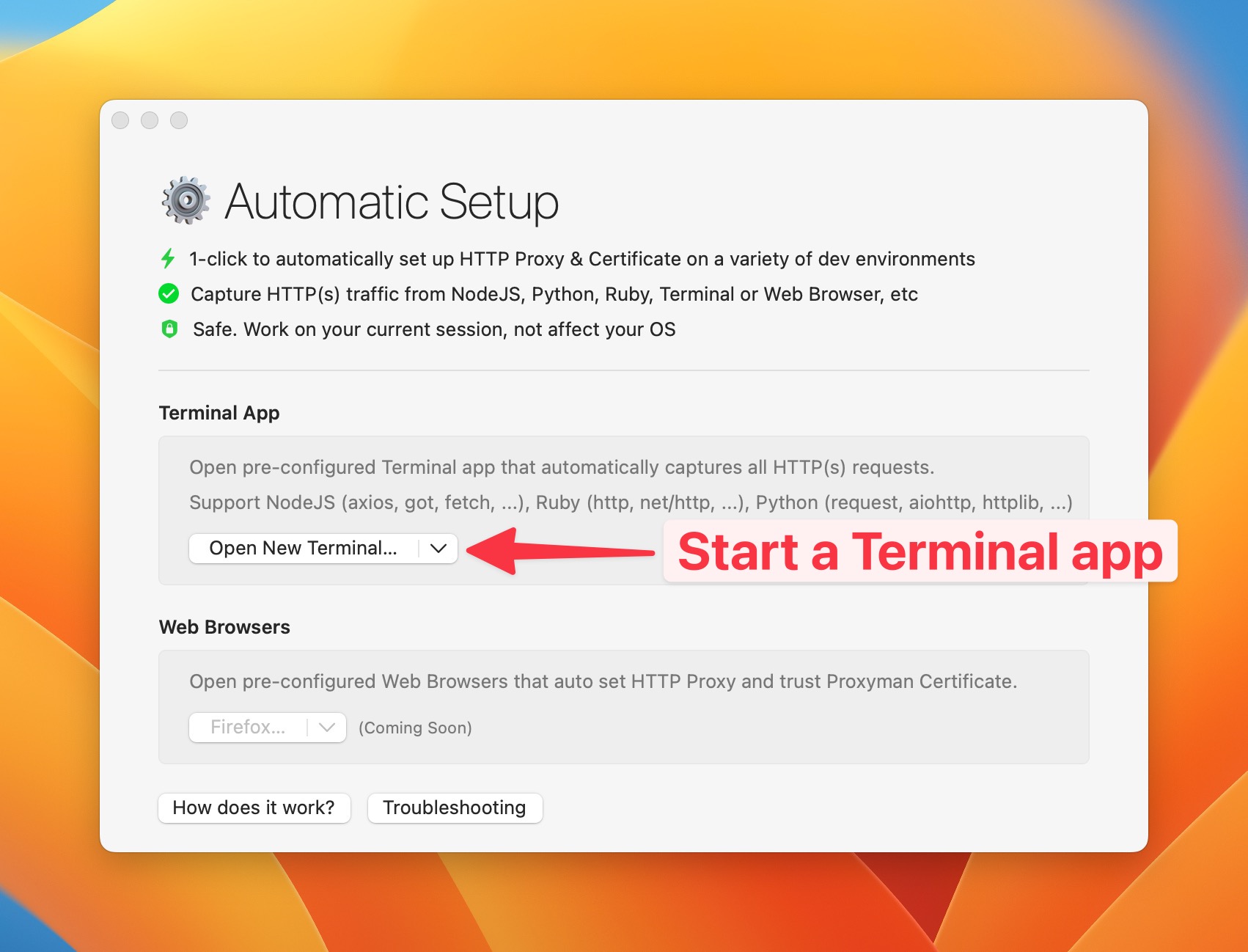
- New Terminal app displays. It's a pre-configured Apple Terminal app, which automatically captures and decrypts HTTPS traffic from Axios.
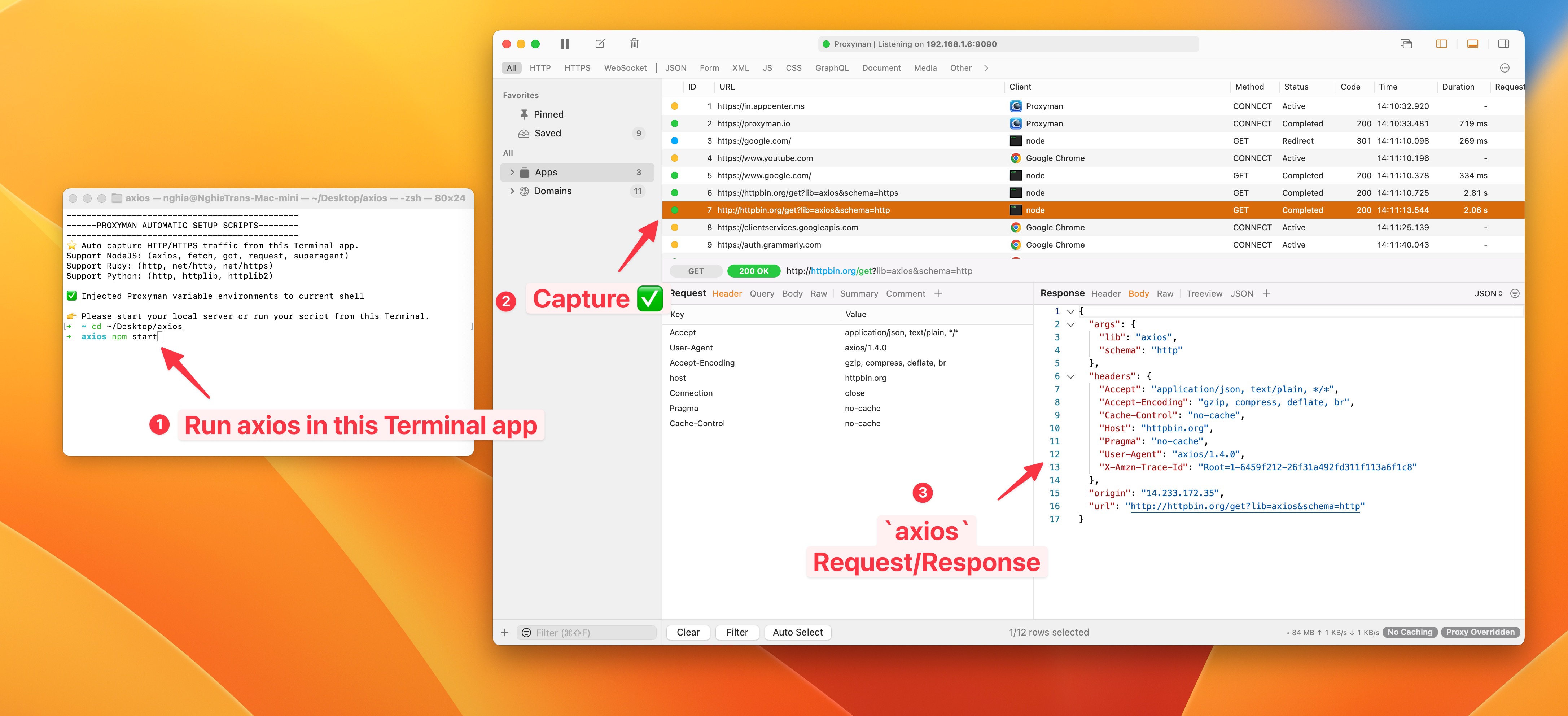
- Let's run:
node main.jsagain on new Terminal app, and now all HTTP/HTTPS traffic is captured and decrypted by Proxyman 🎉
- Done.
- If you'd like to understand how it works behind the scenes, check out this Automatic Setup Documentation
- If you prefer using your own Terminal (iTerm2, or Hyper), you might check out the Manual Setup.
Supported other NodeJS libraries
Proxyman supports: Axios, got, superagent, fetch, and node-fetch out of the box.
Conclusion
It's error-prone and time-consuming to capture HTTP/HTTPS traffic from axios NodeJS scripts. However, it can be done with zero-config and 1-click by using the Automatic Setup from Proxyman.
Run node main.js inside the terminal that Proxyman opens because the setup is limited to that session. It does not change your shell profile. If traffic is still missing, check whether the code supplies its own Axios agent or proxy option, then try a plain Node fetch request in the same terminal to separate an app setting from a setup problem.
Proxyman is a high-performance macOS app, which enables developers to capture and inspect HTTP(s) traffic from apps and domains on iOS devices, iOS Simulators, and Android devices.
Get it at https://proxyman.com/